
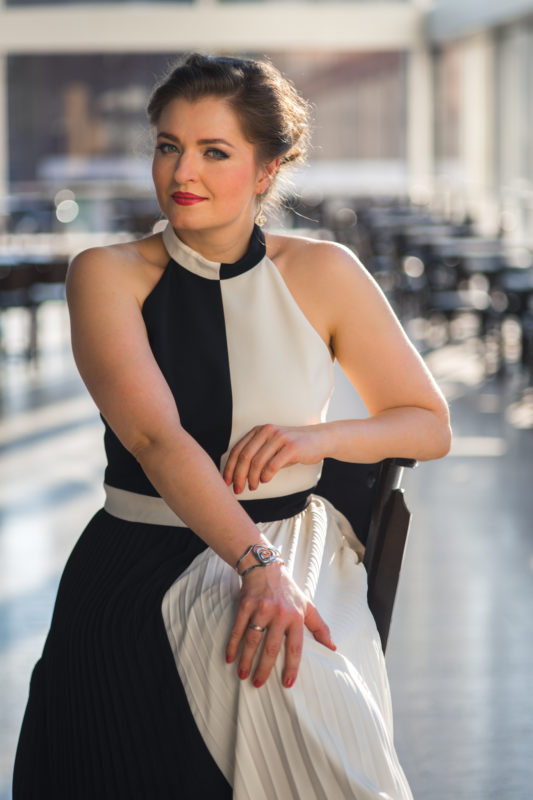
 Ukrainian-German soprano Kateryna Kasper is distinguished by her stylistic versatility in opera, oratorio, and art song. She performs at leading opera houses, concert halls, and festivals worldwide and is renowned for her nuanced, highly expressive interpretations. Her repertoire ranges from Bach’s oratorios and Passions to operatic roles by Handel, Mozart, and Strauss, and Mahler’s symphonies. It also encompasses works by Haydn, Brahms, Mendelssohn, Dvořák, Poulenc, and Henze, as well as an extensive Romantic art song repertoire.
ENGAGEMENTS
In the coming season, Kateryna Kasper makes her house debut at the Theater an der Wien in a new production of Handel’s Rinaldo under the musical direction of Francesco Corti and directed by Nadja Loschky, in which she sings the role of Armida for the first time. She also makes her debut at the Innsbruck Festival of Early Music. A new aria programme Queen Christina’s World takes her together with the Helsinki Baroque Orchestra and Cecilia Bernardini to Helsinki and Riga, while a chamber music programme featuring works by Mozart and Gluck brings her to Santiago de Compostela. With a New Year’s concert featuring arias by Mozart and Haydn with the Symphony Orchestra of the Czech Radio, she returns to Prague. Further projects include performances of Fauré’s Requiem as well as Leonard Bernstein’s Chichester Psalms.
Among her recent successes are her role debuts as Mélisande in Debussy’s Pelléas et Mélisande at the Longborough Festival Opera (UK opera debut), as Cleopatra in Handel’s Giulio Cesare, and as Micaëla in Bizet’s Carmen at the Oper Frankfurt. As Elettra in Mozart’s Idomeneo and Arianna in Vivaldi’s Il Giustino, she appeared with the Freiburg Baroque Orchestra under the direction of René Jacobs at, among others, the Teatro Real in Madrid, the Liceu in Barcelona, the Elbphilharmonie Hamburg, the Palau de la Música in Valencia, the Konzerthaus Freiburg, the Heidelberger Frühling Music Festival, and deSingel in Antwerp. As Arianna, she had previously already been celebrated in Barbora Horáková’s production with the Akademie für Alte Musik Berlin at the Staatsoper Berlin.
Further engagements took her to the Salzburg Festival as Soprano I in Mozart’s Mass in C minor, as well as to the Tonhalle Zürich with Haydn’s The Creation. She also performed Mahler’s Resurrection Symphony at the Gstaad Menuhin Festival under the direction of Jaap van Zweden, Brahms’ A German Requiem together with the Bochum Symphony Orchestra, and Bach’s St John Passion with the Orquesta Filarmónica de Gran Canaria under the direction of Karel Mark Chichon.
With Collegium 1704 under the direction of Václav Luks, she sang the role of Isacco in Mysliveček’s impressive work Abramo ed Isacco at venues including the Rudolfinum in Prague and the Concertgebouw Amsterdam, as well as the title role in Handel’s oratorio Susanna at the Litomyšl Smetana Festival.
With the Basel Chamber Orchestra, she recently performed Handel’s Aci, Galatea e Polifemo in Barcelona, Vienna, and Basel, as well as at the Halle Handel Festival; with the same work, she also made her Canadian debut with the Arion Baroque Orchestra in Montréal.
In the role of Piacere in Handel’s Il trionfo del Tempo e del Disinganno, she appeared together with the B’Rock Orchestra under the direction of René Jacobs at the Tongyeong International Music Festival, the Seoul Arts Center, and Tokyo Opera City.
OPERA
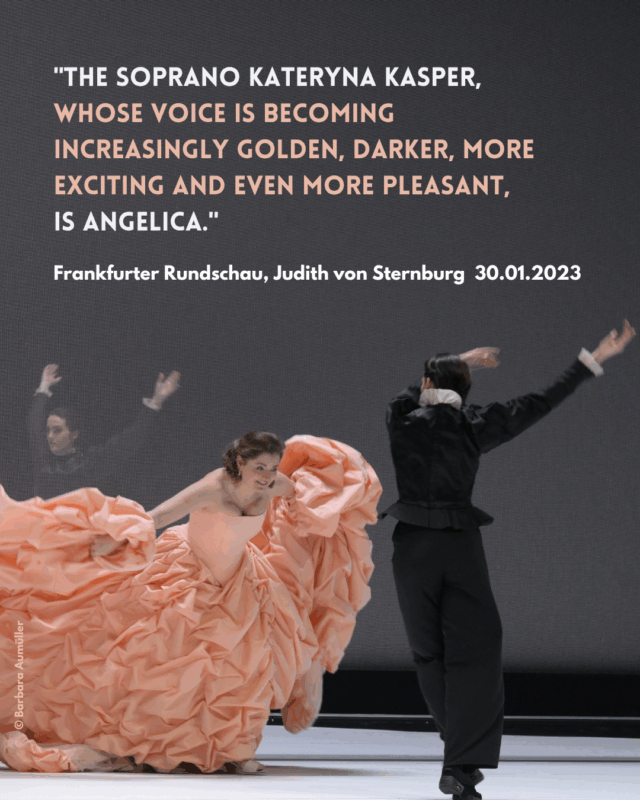
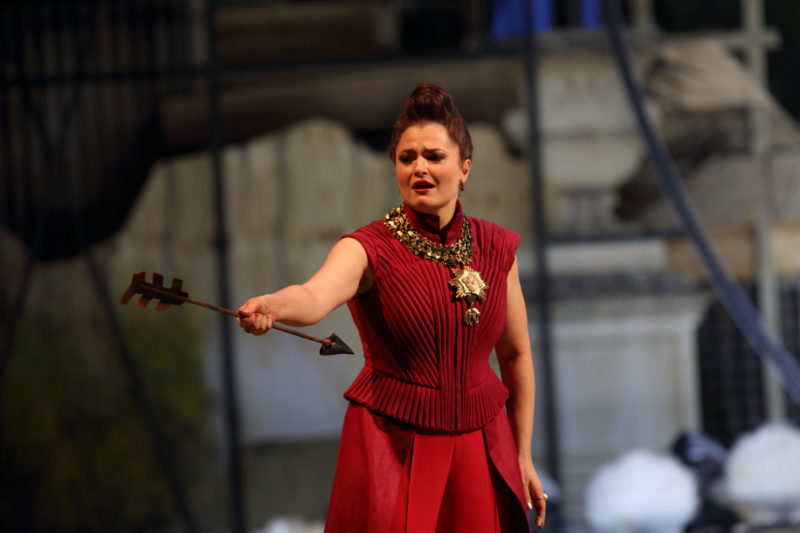
From 2014 to 2024, Kasper was a member of the ensemble at her home opera house, Oper Frankfurt, where she embodied a wide range of roles spanning from Baroque to contemporary opera. These included Anima in Cavalieri’s Rappresentazione di anima e di corpo, Giacinta in Cesti’s L’Orontea, Romilda, Oriana, Angelica, and Tigrane in Handel’s Xerxes, Amadigi, Orlando, and Radamisto; Angelica in Vivaldi’s Orlando furioso; Susanna, Pamina, Zerlina, and Venus in Mozart’s Le nozze di Figaro, Die Zauberflöte, Don Giovanni, and Ascanio in Alba; Antonida in Glinka’s Ivan Susanin; the title role in Flotow’s Martha; Gretel in Humperdinck’s Hänsel und Gretel; Nannetta in Verdi’s Falstaff; Sophie in Strauss’ Der Rosenkavalier; Titania in Britten’s A Midsummer Night’s Dream; and the Young Woman in the world premiere of Der Goldene Drache – a role written for her by Péter Eötvös and presented in co-production with Ensemble Modern. She has also performed operetta roles such as Countess Anastasia in Kálmán’s Die Csárdásfürstin and Valencienne in Lehár’s Die lustige Witwe.
Operatic engagements have taken Kateryna Kasper to festivals in Edinburgh, Bregenz, Bergen, and St. Margarethen, as well as to Los Angeles Opera, Staatsoper Berlin, and Nationaltheater Mannheim. On a European tour with the B’Rock Orchestra under René Jacobs, she performed the role of Orasia in Telemann’s Orpheus, with performances at the Liceu in Barcelona and the Concertgebouw in Amsterdam.
CONCERT

Alongside her international opera career, the concert and art song repertoire forms a central part of Kateryna Kasper’s artistic profile. Her wide-ranging repertoire extends from the Baroque oratorios and Passions – including works by Johann Sebastian Bach and Georg Philipp Telemann – through the great Classical and Romantic works of Haydn, Mozart, Mendelssohn, Schubert, Schumann, Brahms, and Dvořák, to compositions of the 20th and 21st centuries, including works by Poulenc, Stravinsky, and Henze.
She has worked with numerous leading orchestras and ensembles, including the Freiburg Baroque Orchestra, the Akademie für Alte Musik Berlin, Collegium 1704, Ensemble Modern, Holland Baroque, the Konzerthausorchester Berlin, the London Philharmonic Orchestra, the Orquestra Gulbenkian Lisbon, the Orquestra Sinfónica do Porto, and the Turku Philharmonic Orchestra.
She has been a guest at the Bachwoche Stuttgart, the Grafenegg Festival, the Händel Festivals in Halle and Karlsruhe, the Klangvokal Musikfestival Dortmund, the Telemann Festival Magdeburg, and the Tongyeong International Music Festival. Concert engagements have taken her to renowned venues such as the Alte Oper Frankfurt, the Elbphilharmonie Hamburg, the Philharmonies in Cologne, Moscow, and Paris, the Seoul Arts Center, the Théâtre des Champs-Élysées in Paris, and Tokyo Opera City.
A particular focus of her concert repertoire lies in the works of J. S. Bach and G. F. Handel. International recognition was achieved by her tour of Bach’s St Matthew Passion with the Freiburg Baroque Orchestra under the direction of Francesco Corti, which took her throughout Europe and South Korea. She has performed Bach’s Christmas Oratorio among others with the Vienna Symphony Orchestra at the Wiener Konzerthaus, at the Isarphilharmonie Munich under Patrick Hahn, as well as with the Freiburg Baroque Orchestra and the Nederlands Kamerkoor under Peter Dijkstra at the Tauber Philharmonie, the Kölner Philharmonie, and the Konzerthaus Freiburg.
Her further interpretations of Bach include St John Passion with Ensemble Pygmalion under Raphaël Pichon at the Grand Théâtre de Provence, the Philharmonie Paris, the Opéra de Lille, and the Théâtre de Caen. In addition, she has performed numerous sacred works by Bach and Handel with the Bach-Ensemble Wiesbaden under Martin Lutz, Jörg Endebrock, and Tobias Koriath in Wiesbaden, Hamburg, and Frankfurt.
Her interpretations of Handel include Messiah with the NDR Vokalensemble and Holland Baroque under Klaas Stok at the Elbphilharmonie Hamburg. Together with René Jacobs and the Freiburg Baroque Orchestra, she devoted herself to Handel’s virtuoso cantatas Delirio amoroso and Apollo e Dafne, which she performed at the Festival d’Ambronay, the Settimane Musicali Ascona, and the festival Erasmus klingt! in Basel. She has also interpreted works by Pergolesi, including Salve Regina and Stabat Mater, cantatas by Telemann, as well as compositions by Reinhard Keiser, Stradella, and Scarlatti in collaboration with Michael Schneider.

Another focus lies on the concert repertoire of Haydn and Mozart. She performed Haydn’s The Creation at the Tonhalle Zürich under Heinz Bähler, and The Seven Last Words of Our Saviour on the Cross with the RIAS Kammerchor and the Konzerthausorchester Berlin under Justin Doyle; the recording of this concert was released in 2026 by Harmonia Mundi. In addition, she interpreted Haydn’s cantata Miseri noi, misera patria in Oslo with Kristin von der Goltz and the Barokkanerne Norwegian Baroque Ensemble.
With the London Philharmonic Orchestra and the London Philharmonic Choir, she sang Mozart’s Requiem under Nathalie Stutzmann at the Royal Festival Hall in London. Further performances of Mozart’s Requiem and Vesperae solennes de Confessore were given with Hans-Christoph Rademann and the choir and orchestra of the Gaechinger Kantorei at the Théâtre des Champs-Élysées in Paris. With L’Orchestre des Champs-Élysées under Alessandro Moccia, she created a Mozart aria programme, and with the Freiburg Baroque Orchestra under Kristian Bezuidenhout, she performed the concert aria Ch’io mi scordi di te at the Mozartfest Augsburg. Together with the Cologne Chamber Orchestra under Christoph Poppen, she appeared among others with Mozart’s Exsultate, jubilate as well as works by Dieterich Buxtehude and Vasyl Barvinsky.
The Romantic oratorio repertoire also occupies an important place in her concert work. At the Savonlinna Opera Festival, she performed Schubert’s Mass in A-flat major. With the Frankfurt Opera and Museum Orchestra under Sebastian Weigle, she appeared in Mendelssohn’s Paulus and Elijah as well as Schumann’s Scenes from Goethe’s Faust. Her repertoire also includes Dvořák’s Requiem, Stabat Mater, and numerous other works of the sacred choral symphonic repertoire.
Her symphonic concert projects include Gustav Mahler’s Resurrection Symphony at the Menuhin Festival under Jaap van Zweden. She has performed Mahler’s Symphony No. 4, among others, at the Léman Lyriques Festival with L’Orchestre Symphonique Ose under Daniel Kawka, as well as at the Alte Oper Frankfurt with the Frankfurt Opera and Museum Orchestra under Katharina Wincor. The same concert programme also included Franz Schubert’s Die junge Nonne, Gretchen am Spinnrade, Lied der Mignon, and Erlkönig in the orchestral arrangements by Franz Liszt.
Furthermore, she has interpreted Hans Werner Henze’s Being Beauteous with Ensemble Modern under Brad Lubman at the Alte Oper Frankfurt, as well as with the musicians of the Frankfurt Opera and Museum Orchestra.
LIED
With great passion, Kateryna Kasper devotes herself to the art of song, particularly to the German and Ukrainian Romantic repertoire. Together with pianist Dmitry Ablogin, she has developed numerous song programmes and recorded an album featuring songs by the Mendelssohn siblings, including several world premiere recordings of works by Fanny Hensel. Together, they have also explored works by Clara Schumann, Johannes Brahms, Sergii Bortkevych, Vasyl Barvinsky, Stanyslaw Liudkevych, Kyrylo Stetsenko, Yakiv Stepovyi, Mykola Lysenko, Nikolai Roslavets, and Nikolai Medtner. Their joint concerts have taken them, among others, to the HICSUM Festival Herlufsholm in Denmark as well as to the Mirjam Helin Concert for Ukraine at the Helsinki Music Centre. Their interpretation of Robert Schumann’s song cycle Dichterliebe was created in April 2023 as a concert film production at Schloss Weißenbrunn on a historic Pleyel fortepiano from 1836; the film production was realised by Culiner Creative Circle.
Kateryna Kasper has enjoyed a long-standing artistic collaboration with pianist Hilko Dumno. Together, they have created numerous song recitals featuring works by Schumann, Brahms, Schubert, Rachmaninoff, Mussorgsky, Reimann, Bernstein, Prokofiev, Barber, Rimsky-Korsakov, Loewe, Ravel, Messiaen, and Piazzolla. This collaboration also resulted in her debut album O wüßt ich doch den Weg zurück …, recorded at the Richard Wagner Museum Villa Wahnfried.
In addition, Kateryna Kasper collaborates with pianists such as Marcelo Amaral, Lars Jönsson, Jonathan Ware, and Henning Lucius. Together with Marcelo Amaral, she has devoted herself, among other projects, to settings of Goethe by Hugo Wolf, Schumann, and Schubert. With Lars Jönsson, she has developed programmes featuring works by Strauss, Grieg, Poulenc, Debussy, Barber, and Liszt.
Her song repertoire also includes Hindemith’s Das Marienleben as well as Brahms’ Liebeslieder-Walzer.
Another significant chamber music partnership connects her with the Trio Vivente (Kristin von der Goltz, cello; Anne Katharina Schreiber, violin; Jutta Ernst, piano). Together, they perform works including Mieczysław Weinberg’s Jewish Songs for Soprano and Piano Trio, Op. 13, as well as Dmitri Shostakovich’s Romance Suite for Soprano and Piano Trio, Op. 127.
COLLABORATIONS
Kateryna Kasper has worked with conductors such as Heinz Bähler, Ivor Bolton, Roland Böer, Hubert Buchberger, Constantinos Carydis, Karel Mark Chichon, Francesco Corti, Laurence Cummings, Peter Dijkstra, Justin Doyle, Bjarte Eike, Simone di Felice, Bernhard Forck, Michael Form, Alden Gatt, Howard Griffiths, Patrick Hahn, Florian Helgath, James Hendry, Michael Hofstetter, Leo Hussain, Karsten Januschke, Julia Jones, Hartmut Keil, Eun Sun Kim, Yi-Chen Lin, Florian Lohmann, Václav Luks, Martin Lutz, Giuseppe Mentuccia, Takeshi Moriuchi, Fausto Nardi, Anthony Negus, Geoffrey Paterson, Raphaël Pichon, Christoph Poppen, Hans-Christoph Rademann, Helmuth Rilling, Lukas Rommelspacher, Federico Maria Sardelli, Michael Schneider, Leif Segerstam, Steven Sloane, Andreas Spering, John Storgårds, Nathalie Stutzmann, Constantin Trinks, Felice Venanzoni, Sebastian Weigle, Katharina Wincor, Sebastian Zierer, and Jaap van Zweden.
She has enjoyed fruitful collaborations with directors such as Andrea Bernard, Nina Brazier, Jörg Endebrock, Brigitte Fassbaender, Tom Goossens, Claus Guth, Barbora Horáková, Ted Huffman, Netia Jones, Dorothea Kirschbaum, Barrie Kosky, Tilmann Köhler, Harry Kupfer, Benoît de Leersnyder, Jim Lucassen, Hendrik Müller, Cornelius Obonya, Jenny Ogilvie, Caterina Panti Liberovici, Carolin Pienkos, Hans Walter Richter, Victoria Stevens, Elisabeth Stöppler, and Walter Sutcliffe.
A special musical collaboration connects her with conductor René Jacobs and her chamber music partners, the Frankfurt-based ensemble théâtre sans rideau, the Trio Vivente (Kristin von der Goltz, Anne Katharina Schreiber, Jutta Ernst), the Eliot Quartet, as well as pianists Dmitry Ablogin, Hilko Dumno, Marcelo Amaral, and Lars Jönsson.
DISCOGRAPHY
Kasper’s debut album „O wüßt ich doch den Weg zurück …“ brings together songs by 14 composers in a musical journey through the world of Romanticism – shaped by a longing for the mysterious, the irrational, the timeless, and the human, as well as by memories of childhood and imaginary worlds. The recording was made together with Hilko Dumno at the Villa Wahnfried in Bayreuth on Richard Wagner’s historic Steinway grand piano from 1876 and was released in 2018 by TYXart.
In 2022, recordings were released featuring cycles by Shostakovich and Weinberg with the Trio Vivente, Weber’s Der Freischütz with the Freiburg Baroque Orchestra under René Jacobs (awarded the Opus Klassik), as well as her second art song album „Ein süßes Deingedenken“, featuring songs by Fanny and Felix Mendelssohn, recorded with Dmitry Ablogin on a historic fortepiano from 1835 (nominated by the Opus Klassik as Best Chamber Music Recording).
The recording of Haydn’s The Seven Last Words of Our Saviour on the Cross with the RIAS Kammerchor and the Konzerthausorchester Berlin under Justin Doyle was released in 2026.
EDUCATION AND AWARDS
Kasper studied with Raisa Kolesnik at the Prokofiev Music Academy in Donetsk, Ukraine, and subsequently in Nuremberg with Edith Wiens and in Frankfurt with Hedwig Fassbender, supported by a DAAD scholarship. In masterclasses, she worked among others with Ileana Cotrubaș, Margreet Honig, and Tobias Truniger.
In 2014, the soprano won the prestigious International Mirjam Helin Singing Competition in Helsinki. This was preceded by prizes at the International Vocal Competition IVC (Netherlands), the Queen Sonja International Music Competition (Oslo), and the Trude Eipperle-Rieger Lied Prize. In 2023, she was nominated for the OPUS KLASSIK in the category Singer of the Year.


